By Aremuorin — Multi-Award-Winning Songwriter, Artist & Producer
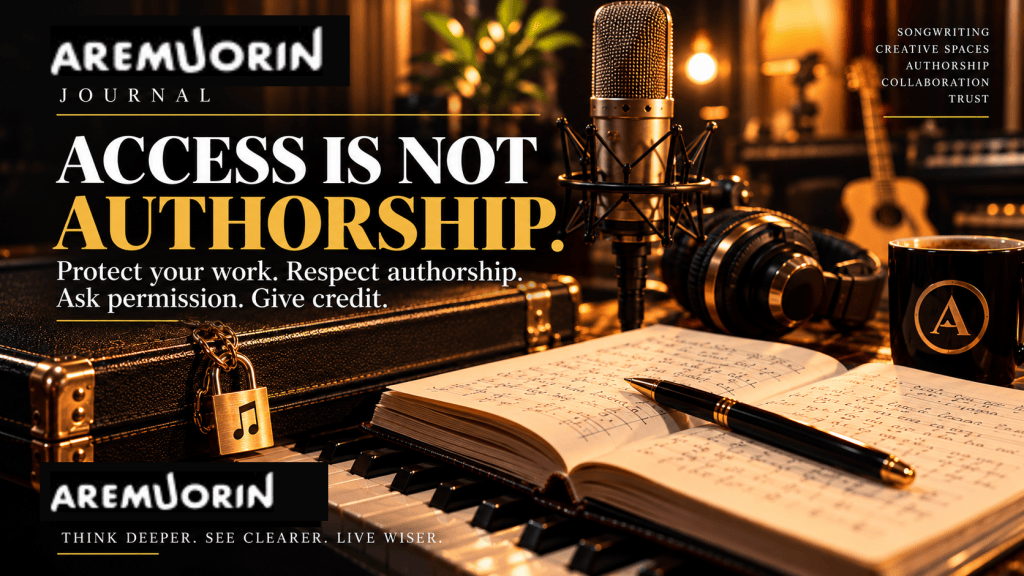
Hearing someone’s work doesn’t make it yours. Rearranging it doesn’t make you its songwriter. Access is not authorship.
Creative spaces should be places where ideas are nurtured, skills are developed, and artists feel safe enough to bring unfinished or finished work into the room.
That distinction matters. A creator may bring a completely finished song into a workshop, rehearsal, writing room or other creative environment simply to perform it, explore it, receive feedback, rehearse it or share it. Being given access to somebody’s work is not the same as being given ownership of it.
Creative spaces should never become hunting grounds for somebody else’s material. These principles protect everyone: songwriters, musicians, producers, singers, poets, authors, performers, visual artists and the communities that depend upon creative trust.
Why I Wrote This
This article began with a moment in a songwriting workshop that left a surprisingly sour taste in my mouth. Before presenting their song, somebody approached me specifically and asked me not to record it.
Let me be clear: they were perfectly entitled to ask. A creator has every right to establish boundaries around the recording of their work, and I respected that boundary.
What irritated me was something different. I had absolutely no interest in recording their song. It was not my project, I had no intention of using it, and I had no desire to acquire anything from it. I have been writing since I was seven, I am a multi-award-winning songwriter, and my own catalogue contains more than 1,000 works. I am not short of songs or ideas.
So being approached personally in that way made me wonder: what exactly about me made you think I wanted your work?
Perhaps it was simply caution. Perhaps the person was anxious. I do not pretend to know another person’s motives.
But it nevertheless made me reflect on something much larger.
And, personally, I found it insulting.
I do not say that because a songwriter has no right to protect their work. They absolutely do. I say it because of what being singled out appeared to imply about me — as though I had some particular interest in acquiring, recording or appropriating somebody else’s song.
I found that bordering on insulting to my professional reputation, both as a songwriter and as a collaborator. I have spent years building my own catalogue. Unless we are actually collaborating, somebody else’s song is simply not my project.
What made the encounter even more irritating was that this was not happening in isolation. Within the same wider creative environment, I had repeatedly brought completed songs of my own into the room to perform, rehearse, try with live musicians, explore harmonies or hear alternative arrangements. Those activities should not be confused with developing or co-writing the underlying songs. The words and music were already written.
I am open to hearing musicians and singers interpret my work differently. That is one of the pleasures of songwriting: a strong composition can survive different voices, instrumentation, genres and arrangements. An arrangement may offer another perspective on a song without becoming the source of the song itself.
That is very different from a genuine co-writing session. On occasions when people in that environment have explicitly said, “Let’s write something together,” I have contributed creatively. Yet there have been instances where I subsequently received neither the resulting recording nor a split sheet documenting those contributions.
At the same time, recordings have been made while I was performing or working with my own material in those spaces, and I have not treated everybody holding a phone as somebody attempting to steal my catalogue.
That is the contradiction that bothered me. My work could enter the room, be performed around, recorded and interacted with without me immediately assuming bad faith. Yet when somebody else presented their own work, I was specifically approached as though I needed to be warned not to record it — when I had no interest whatsoever in doing so.
That inevitably made me ask: why was that suspicion being directed at me?
What troubled me further was what happened when I attempted to resolve the matter directly. I wanted to have a conversation about why I had been singled out and why the request had concerned me. I was told, in effect, that the conversation was over for them.
That made the experience considerably more uncomfortable. A boundary had been brought directly to me, which I respected, but when I wanted to discuss how that interaction had affected me, there was apparently no corresponding willingness to hear my concern.
The explanation I later received — through the host rather than directly from the person concerned — was that anxiety may have been involved and that the work had not yet been registered with PRS. I can have compassion for somebody feeling anxious about protecting their creativity. But PRS registration is not what creates copyright in a song, and anxiety does not make communication and consistency unimportant.
If you are entitled to approach me about your concern, I am equally entitled to say how that approach landed with me. You do not have to agree with my interpretation, but dialogue cannot operate in only one direction.
That inability to have the conversation ultimately affected my trust more than the original request did.
Perhaps it was entirely innocent caution. Perhaps it reflected anxiety about protecting their work. But when standards around recording, consent and documentation have not been consistently applied to everybody’s material, selectively directing that concern at one creator can feel less like a neutral boundary and more like a judgement about that person’s integrity.
I cannot know whether that was anxiety, inconsistency, projection or something else, and I am not going to pretend that I can. What I can say is that it made me feel that my professional integrity had been questioned — and I resented that.
There should not be one standard for your friends and another for everybody else. If recording requires permission, establish that rule for the room. If collaboration requires documentation, document everybody’s contributions. If authorship deserves respect, respect everybody’s authorship.
Creative ethics cannot be selective.
And because I was not able to have that conversation directly, writing this article became the most constructive way for me to process what happened, get it off my chest and turn an uncomfortable experience into something potentially useful for other creators who may find themselves navigating similar questions about boundaries, trust, recording, collaboration and authorship.
Creative trust has to work in both directions. Protect your work, certainly — but extend to other creators the same integrity, consent and respect that you expect for yourself.
An Arrangement Does Not Make the Song Yours
Suppose somebody brings a song into a creative space and you hear possibilities for it. Perhaps you imagine different harmonies, another rhythm or a great new arrangement. Wonderful. That still does not make the underlying song yours.
If you experiment with somebody else’s work, an arrangement remains an arrangement; it does not automatically make you the songwriter. PRS for Music’s distribution policy reflects that distinction: for an arrangement of a copyright musical work, it does not usually allocate an arranger share unless the interested parties have agreed otherwise.
Respect begins with a very simple conversation: ask.
What Copyright Actually Protects
In the UK, copyright protection arises automatically for original musical, literary, dramatic and artistic works; there is no general copyright-registration requirement. The creator is usually the first owner of copyright, subject to important exceptions such as certain works created in the course of employment and any rights that have subsequently been transferred.
Copyright can cover different layers of a musical project. The underlying song or composition, a sound recording and a performance are not necessarily the same right. Permission to hear or rehearse a song is therefore not a blanket permission to copy, record, distribute, adapt or commercially exploit it.
This article offers general creative-rights information, not individual legal advice.
Hearing It in the Room Doesn’t Mean You Wrote It
Hearing a song for the first time does not make you its writer. Being present when somebody performs an original work does not make you a co-writer. Suggesting an arrangement does not automatically transfer authorship of the underlying composition to you.
Access is not authorship. Exposure is not ownership. Collaboration is not appropriation.
Recording Someone Else’s Work? Ask First
Creatives should also think carefully before recording another person’s original material in a workshop or creative space. If somebody is presenting original work, do not assume that simply being in the room gives you permission to record it.
Ask. This becomes especially important where recordings could leave the room, enter studios, circulate among other artists or become reference material for another project. When creators believe material they share may be taken elsewhere without their knowledge, trust disappears.
When Trust Goes, the Best Work Goes With It
If creators begin believing that bringing original material into an environment means somebody may record it, imitate it, appropriate it or rush away and develop something substantially derived from it, eventually those creators will stop bringing their best work.
Everybody loses. The extraordinary song that might have inspired you stays at home. The unusual melody that might have expanded your musical vocabulary never enters the room. The artist whose creativity might have elevated everybody around them becomes guarded.
Creative communities depend upon trust. Abuse that trust and the very thing enriching the room disappears.
Inspiration Is Not the Problem
We all encounter music, art, literature and people who inspire us. Creativity has always existed in conversation with other creativity. But inspiration and appropriation are not synonymous.
There is a difference between hearing something extraordinary and allowing it to inspire your own creativity, and taking somebody else’s imagination and attempting to make people believe it came from you.
For me, the latter is lowbrow. It lacks wit. It lacks wisdom. It is creatively uninspiring. Quite frankly, I do not want to surround myself with that mentality. When everybody goes left, my instinct has often been to go right. What joy is there in building your creative identity around somebody else’s imagination?
Give Credit. Ask Permission.
If you admire another person’s work, there are honourable ways to engage with it. Tell them. Credit them. Ask to collaborate. Ask whether you may arrange, record or use their work. Where permission or a licence is required, obtain it.
“I love what you’ve created. May I work with it?”
That conversation could lead to something better than either person would have created independently. Trying to be slick is unnecessary.
Before You Take a Song Into the Room
- Keep dated drafts, demos and lyric sheets.
- Retain session files and relevant correspondence.
- Agree genuine co-writing contributions and splits as early as practical.
- Establish whether recording is permitted in the room.
- Document permissions, licences and important agreements.
- Make sure credits accurately reflect who actually created what.
Professional documentation is not hostility towards collaboration. It can make collaboration safer.
My Catalogue Is Not an Open Library
I say all of this both as a matter of principle and from the perspective of a multi-award-winning songwriter with a catalogue of more than 1,000 works.
Those works represent years of writing, recording, experimentation, performance and creative development. The fact that somebody encounters one of those works for the first time does not mean the work appeared from nowhere — and it certainly does not mean it belongs to the person who has just heard it.
I take the authorship and integrity of my catalogue seriously. Where protected elements are reproduced, attributed or exploited without appropriate permission, I reserve the right to protect my work through the appropriate professional and legal channels.
Beyond the potential legal implications, I have not one iota of respect for anyone who knowingly takes another creator’s work and attempts to present it as their own — whether the original creator is living or dead.
If You’re Struggling, Ask for Help
If you are struggling to come up with original material, ask for help instead of clowning.
There is no shame in learning, seeking mentorship, collaborating, being an arranger rather than the songwriter, acknowledging inspiration or giving another creator their rightful credit. The problem begins when somebody wants the credit without having done the creating.
This Is for Everybody’s Benefit
This is not simply about protecting my catalogue. It is for the benefit of everyone and for the workshops, writing rooms, rehearsal spaces and creative communities that depend upon people feeling safe enough to share something precious.
We should want creative environments where somebody can bring an extraordinary piece of work into the room without immediately wondering who has their phone out recording it. Where collaboration means collaboration. Where inspiration remains inspiration. Where an arrangement is acknowledged as an arrangement. Where authorship is respected. And where somebody else’s brilliance encourages you to discover your own.
Protect your work. Respect authorship. Credit your collaborators. Ask permission. Get the appropriate licence where required. Document your creativity.
Get your own. Create your own. Give credit where it is due.
— Aremuorin
Creator Rights: Further Reading
For authoritative UK guidance, see the UK Intellectual Property Office guidance on copyright protection, ownership and using somebody else’s intellectual property, alongside PRS for Music’s distribution policy on arrangements and writer interests.
About Aremuorin
Aremuorin is a multi-award-winning songwriter, artist, producer, performer and writer with a catalogue spanning more than 1,000 works. His multidisciplinary creative practice encompasses music, performance, independent publishing and cultural commentary.


Leave a Reply