
Multi-Awarded Writer & Humanitarian | Using art, advocacy, storytelling & tech to transform lives. Written by Aremuorin / Contact / Mailing List / Linktree / Latest Post – Let’s keep the conversation!
AREMUORIN AVAIL ON: >> Click On SPOTIFY : APPLE MUSIC : AMAZON MUSIC : YOUTUBE << Click On <<
Why advancing the speed of creation does not diminish the soul of art
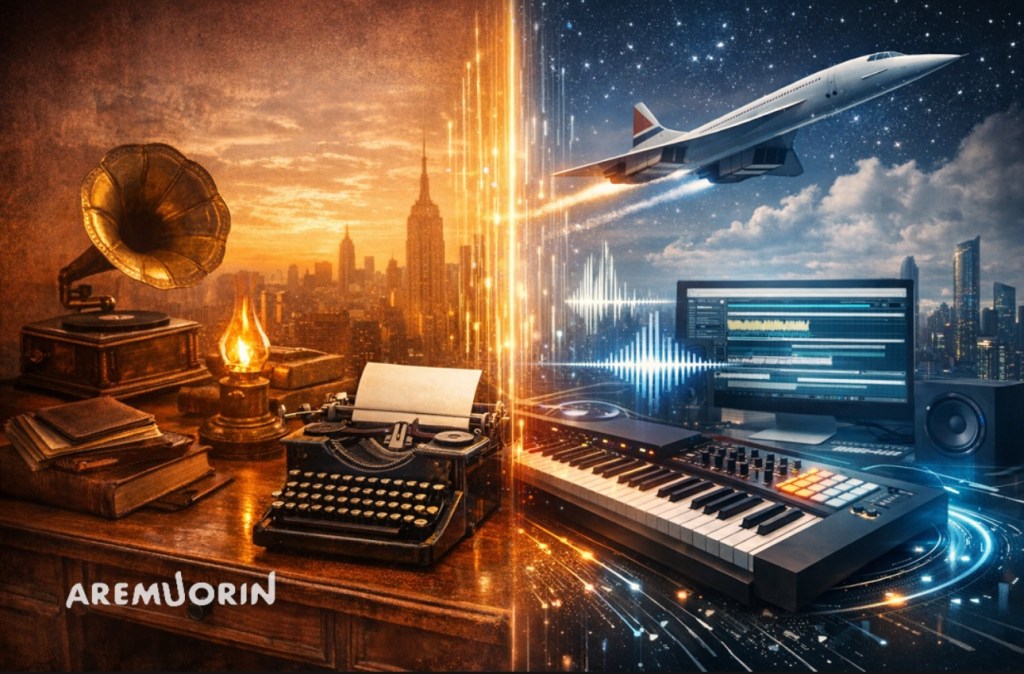
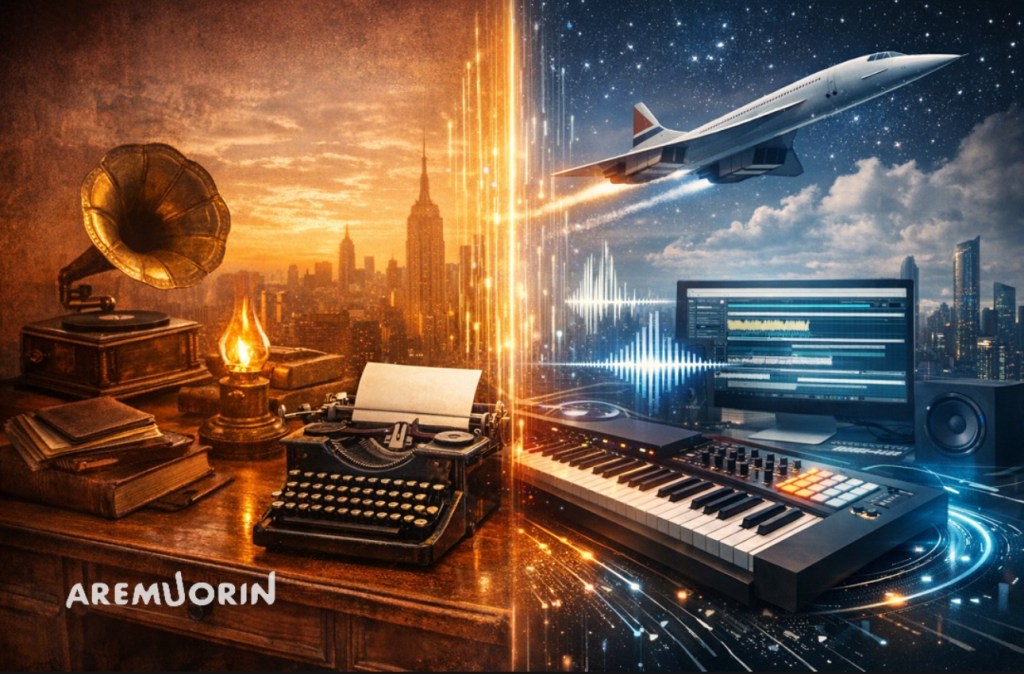
Every era mistakes acceleration for erosion.
We have done this before — repeatedly — and history has been unforgiving to the fear.
There was a time when writing by hand was the only legitimate act of authorship. Thought was inseparable from ink, and legitimacy was measured by slowness. Then came the typewriter. Typists were feared, then displaced. Writing accelerated. Ideas traveled faster than the hand once carried them. The criticism was familiar: something essential was being lost.
Later came word processors. Then computers. Then software that now takes meetings, minutes, and entire conversations and returns structure, summaries, and clarity in moments. Each technological leap revived the same anxiety, articulated with the same moral weight.
In today’s world, no serious thinker argues that a novel typed on a laptop is less literary. It is not considered inferior to one written with a quill.
We did not lose thought.
We removed friction.
Technology does not erase authorship — it compresses latency
The central misunderstanding of our present moment, particularly in music, is the belief that speed negates legitimacy.
As though a composer who hears a song fully formed in their mind is somehow less worthy because they choose tools that allow that inner music to manifest faster.
This is a strange argument when examined honestly.
If I choose to travel to New York, I may walk. I may take a bus. I may cross water by canoe. Or I may board a Concorde. The destination does not change. The intention does not change. Only the latency does.
No one argues that the traveller who flies arrived less authentically than the one who rowed.
We accept this logic everywhere — except, curiously, when art accelerates.
Music has always been technological
The history of music is not a story of purity. It is a story of tools.
- The piano was once an intrusion.
- Amplification was once sacrilege.
- Multitrack recording was once “cheating.”
- Synthesizers were once “not real instruments.”
- Digital audio was once “soulless.”
Each time, practitioners declared the end of music as they knew it.
Each time, music continued — broader, more accessible, and more plural.
The present anxiety around AI-assisted creation is not unique. It is simply the latest iteration of an old fear: the fear that one’s hard-earned mastery of an older toolset may no longer be the sole gate to legitimacy.
This fear is human.
It is understandable.
But it is not truth.
Purism confuses process with essence
Music does not reside in microphones, studios, notation software, or even instruments.
Music resides in decision-making.
- What emotion is pursued?
- What harmony is chosen?
- What restraint is exercised?
- What silence is allowed?
A composer who hears a progression internally and uses advanced tools to realise it has not outsourced authorship — they have removed delay.
We do not accuse architects of fraud for using CAD instead of charcoal.
We do not accuse filmmakers of artifice for editing digitally instead of cutting tape.
Why then does music alone carry this moral burden?
What is actually being resisted
Let us be honest.
What many purists fear is not the loss of music, but the loss of monopoly over production pathways. When the means of manifestation become more accessible, authority shifts from process ownership to taste, discernment, and vision.
That is uncomfortable.
Because taste cannot be certified.
Vision cannot be licensed.
And emotional intelligence cannot be automated.
The studio is no longer the only sacred space.
The composer’s inner life has returned to the centre.
The movement ahead of its time
This moment is not about replacing musicians. It is about re-centering the artist.
The future belongs to those who:
- use advanced tools without surrendering taste,
- accelerate workflow without sacrificing humanity,
- and understand that sincerity is audible regardless of method.
Listeners already know this. The wider world has moved on. They ask only one question:
Does the music move me?
Not: Was it slow enough?
Not: Was it difficult enough?
Conclusion: friction was never the proof of worth
We once believed walking was nobler than riding.
That handwriting was purer than typing.
That tape was holier than digital.
We were wrong every time.
The measure of art has never been the difficulty of its tools, but the truth of its outcome.
To compose faster is not to compose falsely.
To use better tools is not to diminish the soul.
To remove delay is not to remove meaning.
It is simply to arrive — sooner — at what was already there.
Addendum: On Consensus and Quiet Agreement
Voices that have already moved on
No movement advances alone. What often appears radical in one corner of an industry has already become quietly accepted in another.
The present shift in music-making is not driven by novelty, but by convergence — a rare alignment between creators, listeners, and interpreters of culture.
Journalists and cultural critics
Across long-form cultural commentary, a refrain has emerged:
Technology does not threaten art — it reveals what artists choose to do with it.
Critics increasingly focus less on how music is made and more on why it resonates. The question of tooling has given way to discussions of intent, authorship, and emotional coherence. This is not avoidance; it is discernment.
Tastemakers and curators
Playlist editors, radio programmers, and independent curators operate under a simple mandate: retention.
They have learned, often before institutions, that listeners do not abandon songs because of their origin — they abandon them because they feel hollow.
As one seasoned curator put it privately:
“We don’t program processes. We program feeling.”
Respected artists and working musicians
Among experienced musicians — particularly those who have lived through multiple technological shifts — the posture is notably pragmatic.
They recognise the pattern.
“Every generation believes the tools they mastered are the last legitimate ones.”
Many of today’s most respected artists are neither evangelists nor opponents of new technology. They simply incorporate what serves the song and discard what does not.
Their loyalty is not to method, but to outcome.
Producers and engineers
Ironically, those closest to the machinery often see the clearest.
Veteran producers understand that:
- speed does not negate skill,
- automation does not erase taste,
- and tools do not make decisions — people do.
One longtime engineer summarised it succinctly:
“Bad taste is still bad taste. No machine fixes that.”
Listeners and consumers
Perhaps the most decisive voice is the quietest.
Listeners have already moved on.
They share what comforts them.
They replay what moves them.
They ignore what feels synthetic — regardless of pedigree.
The market has rendered its verdict with indifference to debate.
“If it feels human, it is human enough.”
The shape of the coalition
What is emerging is not a rebellion, but a coalition of the unbothered:
- artists who create without apology,
- listeners who respond without prejudice,
- and cultural intermediaries who no longer mistake friction for virtue.
This is how durable shifts take root — not through argument, but through quiet adoption.
Closing note
Movements are rarely announced by consensus statements.
They are revealed when resistance grows loud after practice has already changed.
By the time the debate reaches its most fervent pitch, the future is usually already in use.
Multi-Awarded Writer & Humanitarian | Using art, advocacy, storytelling & tech to transform lives.
Written by Aremuorin / Contact / Mailing List / Linktree / Latest Post – Let’s keep the conversation going !!!
(C) 2025 Aremuorin – All Rights Reserved
 Aremuorin™
Leave a comment