
By Aremuorin™ / Contact / Mailing List / Linktree / Latest Post / Telegram – Let’s keep the conversation going !!!
• Culture • Relationships • 12 min read

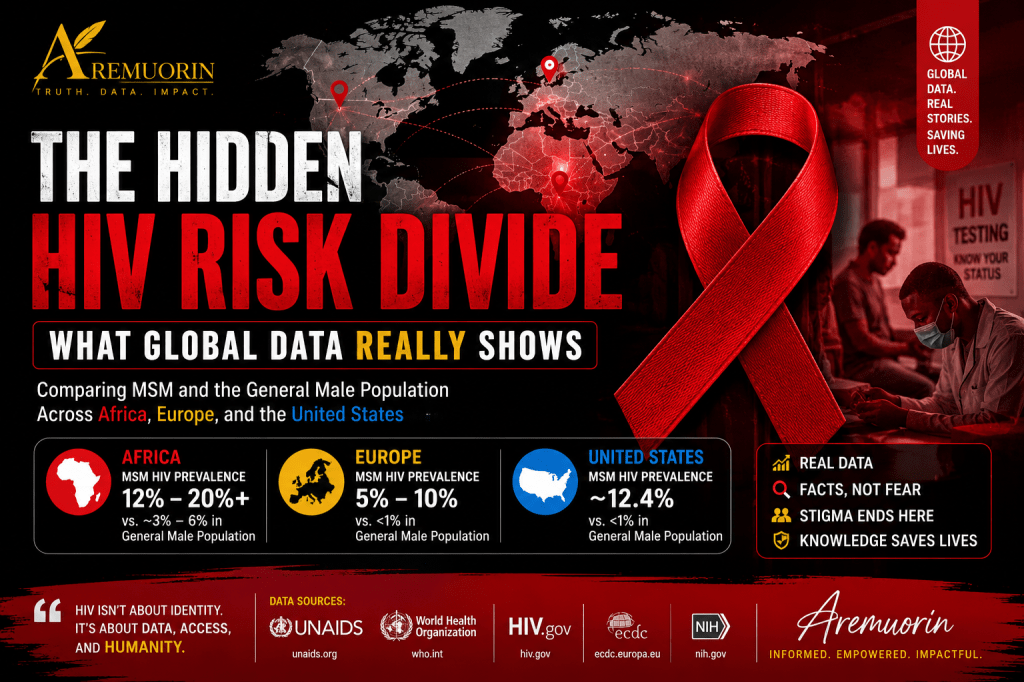
For years, conversations around HIV, sexuality, and secrecy have been shaped more by stigma than by data.
My work is informed by lived experience within communities where faith, identity, and behaviour don’t always align — creating silence, secrecy, and increased health risk.
This article examines what global public health data actually shows about:
- Men who have sex with men (MSM)
- Comparative HIV burden vs heterosexual men
- Regional differences: Africa, Europe, and the United States
- The role of stigma, secrecy, and marriage
Understanding the Terminology
Public health bodies like the WHO and UNAIDS use the term MSM (Men Who Have Sex With Men).
This includes:
- Gay men
- Bisexual men
- Men identifying as heterosexual but engaging in same-sex behavior
- Married men with undisclosed same-sex relationships
This distinction is critical because HIV risk is tracked by behavior, not identity.
Global HIV Overview
- ~40.8 million people living with HIV globally
- ~1.3 million new infections annually
- Sub-Saharan Africa accounts for over two-thirds of cases
Source: UNAIDS Global Factsheet
Key Insight: Relative Risk (MSM vs General Male Population)
The most reliable way to compare populations is through relative prevalence and risk.
Global Pattern
- MSM are estimated to be 20–30 times more likely to acquire HIV than the general male population globally
Source: WHO MSM HIV Data
Africa vs USA vs Europe — Data Comparison
| Region | MSM HIV Prevalence | General Male Population | Relative Risk |
|---|---|---|---|
| Sub-Saharan Africa | ~12% – 20%+ (some studies higher) | ~3% – 6% | 3x – 6x higher |
| United States | ~12.4% | <1% | ~100x higher |
| Western Europe | ~5% – 10% | <1% | 10x – 20x higher |
Sources:
WHO
HIV.gov (USA)
Peer-reviewed meta-analyses (NIH / PubMed Central)
United States: Concentrated Epidemic Among MSM
- 67% of new HIV infections occur among MSM
- 87% of male HIV cases are among MSM
Source: HIV.gov
Africa: High Burden + Underreporting
In many African countries:
- MSM HIV prevalence is significantly higher than the general population
- Criminalization and stigma reduce testing and reporting
- Hidden populations make precise measurement difficult
Some studies report MSM prevalence exceeding 15–20% in multiple countries.
Source: NIH Study
Europe: Lower Overall, But Same Pattern
- Lower national HIV prevalence overall
- MSM remain the most affected group
- Better outcomes due to testing, PrEP, and treatment access
Source: ECDC Europe HIV Reports
The “Married Men” Question
Research confirms that some MSM:
- Are married to women
- Do not disclose same-sex activity
- May form “bridge populations” between sexual networks
However:
There is NO global evidence proving married “down-low” men are the primary driver of HIV epidemics.
Major drivers identified instead:
- Limited testing
- Stigma and criminalization
- Lack of PrEP access
- Undiagnosed infections
Source: WHO / UNAIDS reports
The Real Issue: Risk vs Narrative

HIV is not driven by identity.
It is driven by:
- Exposure risk
- Testing gaps
- Treatment access
- Social conditions
When stigma increases, disclosure decreases — and risk becomes harder to manage.
Conclusion
The data is clear:
- MSM populations face significantly higher HIV burden globally
- This pattern exists across Africa, the United States, and Europe
- But simplistic narratives about “down-low married men” do not reflect the full reality
A data-driven conversation — not a fear-driven one — is what actually saves lives. The bigger warning
UNAIDS is also warning that international funding cuts could reverse decades of progress, potentially leading to millions of additional infections and deaths if prevention and treatment programs are disrupted.
HIV is no longer primarily a medical failure. Increasingly, it is a social, behavioural, and access-to-care challenge. The medicines exist; the remaining barriers are testing, disclosure, stigma, prevention uptake, and consistent treatment.
Sources
- UNAIDS Global HIV Data
- WHO HIV & MSM Data
- HIV.gov Statistics
- NIH MSM Africa Study
- European CDC Report
Aremuorin is a Multi Awardee Conscious Writer · Holistic Jazz Soul Singer-Songwriter · Author · Producer · No1, 49+ Weeks, Jazz Charts. © 2026 MercyfulGrace Records / Aremuorin All Rights Reserved.
© Aremuorin — Thoughts. Culture. Truth.


Leave a comment