
By Aremuorin
There is a moment in almost every entrepreneurial journey when an idea needs more than passion. It needs resources, relationships, strategy and, sometimes, investment.
But before asking someone to fund an idea, there is a more important question: what exactly are you asking them to believe in?
Funding should not be the beginning of the story. It should help accelerate a story that a founder can already articulate.
Funding Follows Clarity
A founder should be able to explain, simply: What problem am I solving? Who am I solving it for? Why does my solution matter? What evidence suggests there is a market for it? And what becomes possible when capital is introduced?
This is not merely presentation. It is clarity of purpose.
Lead With the Value You Create
Entrepreneurs naturally think about what they need: funding, investment, introductions, partners or expertise. An investor is considering a different question: what can this become?
That changes the conversation. Instead of simply saying, “I need funding,” the stronger proposition is: here is the value already being created; here is the opportunity; here is the evidence; here is where it can go; and here is what additional capital enables us to achieve.
Evidence Turns Vision Into a Proposition
Vision matters. But vision becomes more persuasive when accompanied by evidence. That evidence might be revenue, customers, audience growth, intellectual property, partnerships, successful pilots, repeat demand, industry recognition, proprietary technology—or another credible demonstration that the proposition has value.
Not every startup will have the same evidence at the same stage. What matters is knowing what has already been validated, what remains to be proved and being able to communicate the distinction with confidence.
Know Your Numbers
Creative founders can sometimes be uncomfortable moving from vision into numbers. We shouldn’t be. Numbers tell another part of the story.
What does it cost to deliver the product? How does the business make money? What does growth cost? What would new investment actually pay for? What milestones should that investment make possible?
The objective is not to pretend that every projection will come true. It is to demonstrate that ambition has been accompanied by thought.
The Founder Is Part of the Proposition
Investors are not evaluating an idea in isolation. They are also evaluating the people entrusted with executing it. Experience matters. So do judgement, resilience, expertise, relationships, credibility and the ability to adapt.
A founder therefore needs to answer another question: why me? Not from ego, but from evidence. What combination of experience, knowledge, relationships, intellectual property, lived understanding or track record gives you an unusual ability to solve this particular problem?
Capital Should Have a Job
One of the most useful disciplines before fundraising is deciding what the money is actually for. Not simply, “We are raising £X,” but: “We are raising £X to accomplish Y, moving the business from A to B.”
Capital might finance product development, technology, talent, marketing, manufacturing, expansion or another defined growth objective. Whatever the answer, money should have a job.
Relationships Before Transactions
There is another form of capital entrepreneurs sometimes underestimate: relationships.
The person you meet today may never invest in your company. They may nevertheless introduce you to the person who does—or become an adviser, customer, collaborator, mentor or strategic partner.
That is why professional networking should not become a room full of people asking each other for things. The strongest networks are ecosystems of reciprocal value.
Before You Ask
Before walking into the next investor meeting—or posting the next fundraising request—consider the essentials: the problem you solve, the value you have already created, the evidence supporting the opportunity, why you are equipped to build it, how the business creates sustainable value, and precisely what investment would enable you to accomplish.
If those answers are clear, the funding conversation changes. You are no longer simply asking somebody to finance an ambition. You are inviting them to understand an opportunity.
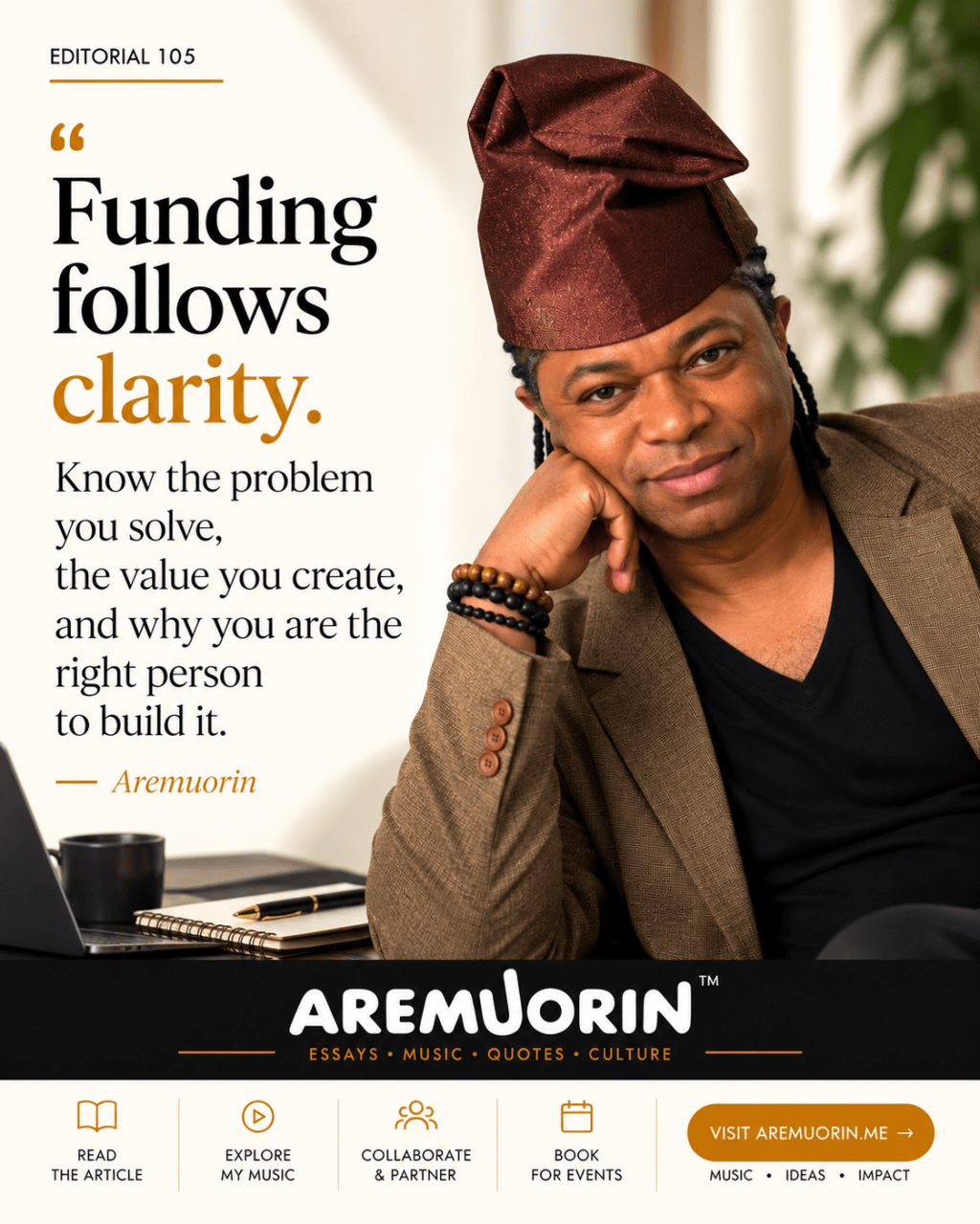
“Funding follows clarity. Know the problem you solve, the value you create, and why you are the right person to build it.”
Aremuorin — Editorial 105
Ideas become stronger through the right conversations.
If you are building, investing, commissioning, partnering or exploring thoughtful creative and entrepreneurial collaboration, discover more of Aremuorin’s work and start a conversation.
#Aremuorin #Entrepreneurship #Startups #Investment #Fundraising #Founders #Business #Leadership


Leave a Reply