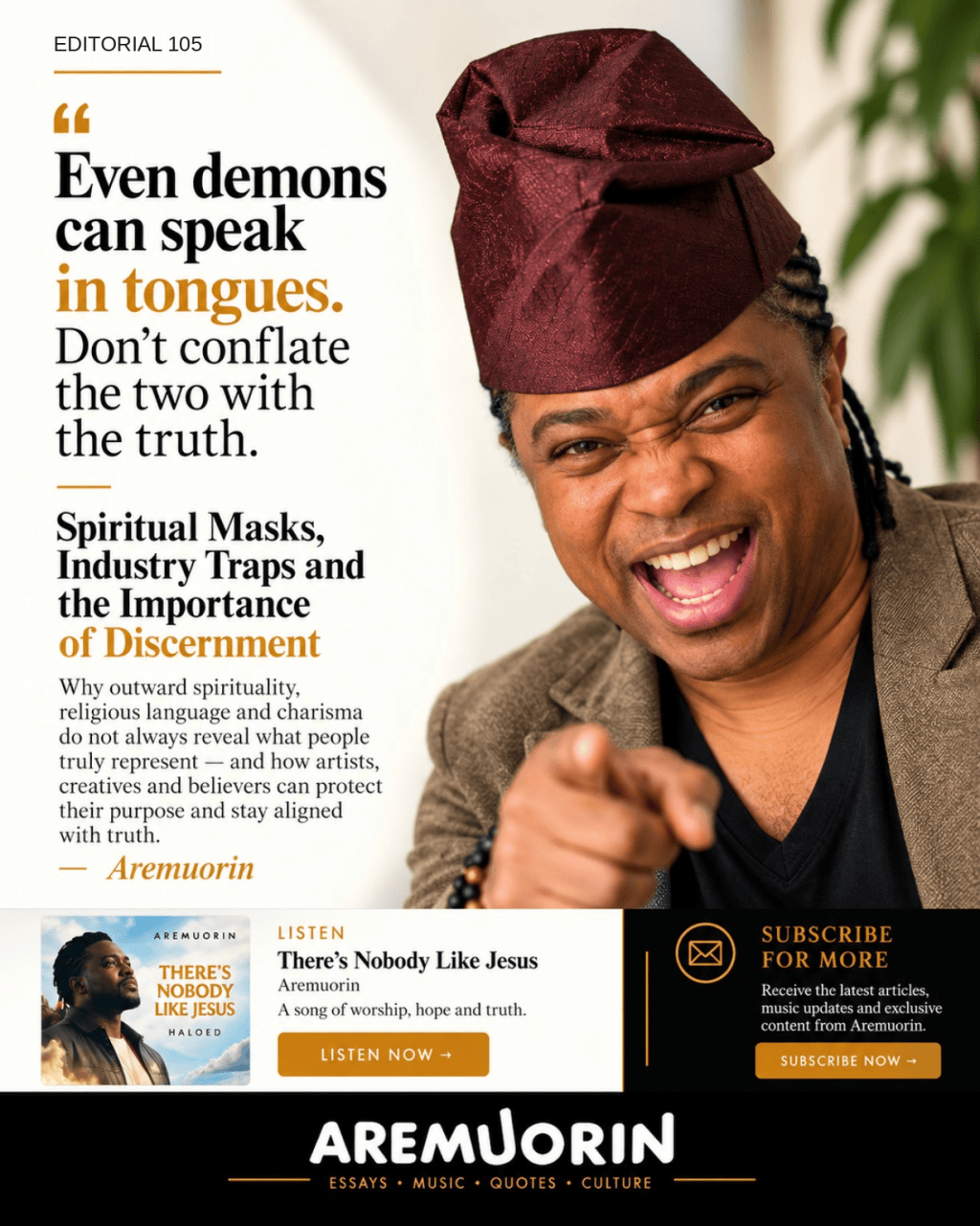
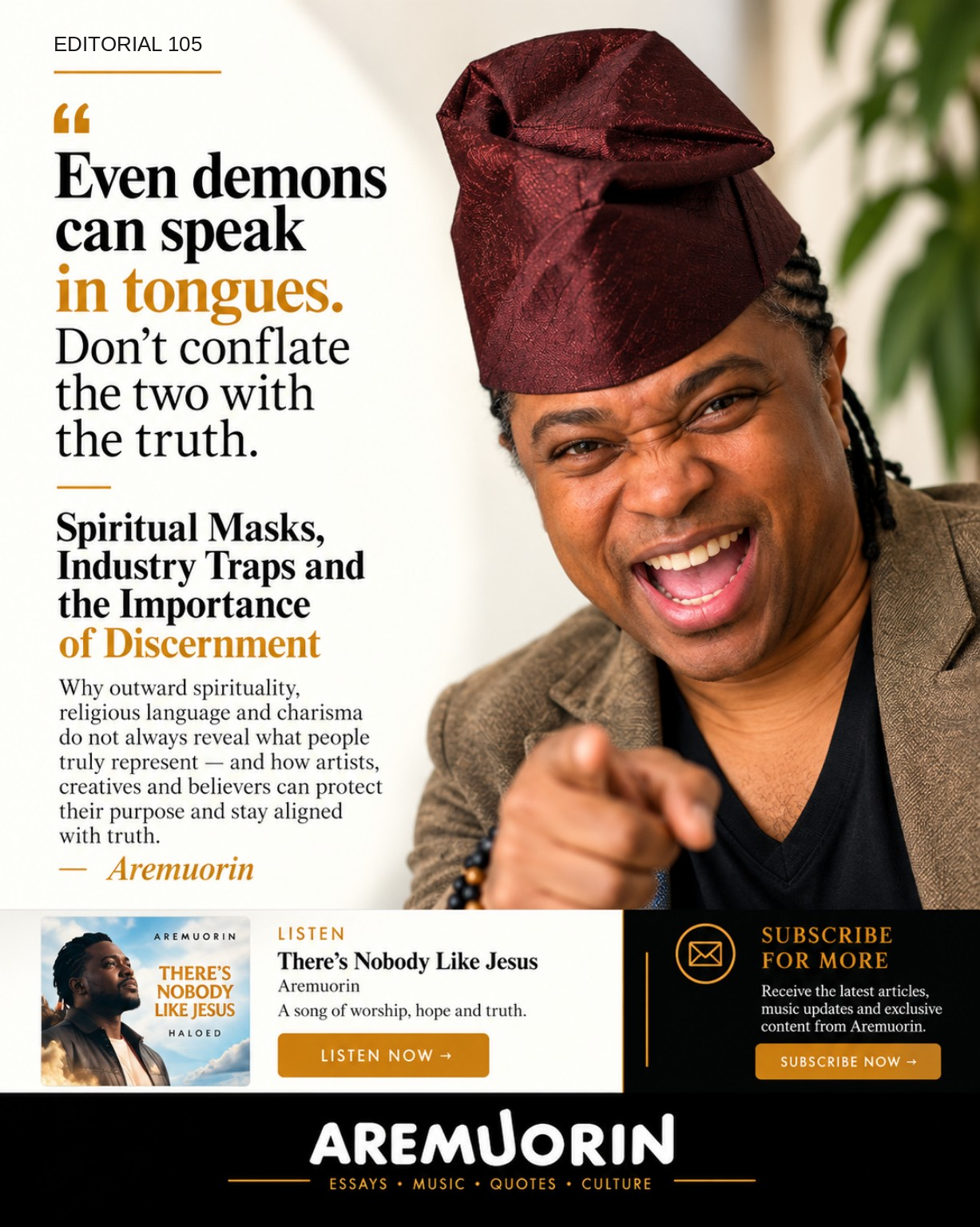
“Even demons can speak in tongues.
Don’t conflate the two with the truth.”
— AREMUORIN · EDITORIAL 105 —
A cover story on spiritual performance, symbolic affiliations, professional gatekeeping and the right to protect your conscience.
The mask is not the message
Not everyone who speaks about God lives by the principles they profess. That observation is not an attack on Christianity, worship or the gift of tongues. It is a reminder that spiritual vocabulary is not a character reference. A person may quote Scripture beautifully and still be evasive about a contract, dismissive of a boundary or careless with someone else’s trust.
A person may know every hymn, quote Scripture fluently, speak in tongues, and still fail the simplest test of character: how they treat other people. Faith is not a costume, charisma is not evidence, and a religious vocabulary is not a certificate of integrity.
I am writing especially for artists, songwriters and emerging creatives. When you are hoping for your first major opportunity, it can be tempting to trust someone who appears spiritually familiar, offers to pray for your career, or promises introductions to influential people. Yet a shared religious language should never replace due diligence, consent or clear professional boundaries.
Behind the symbols: belief, belonging and personal choice
Conversations about occultism, symbolism, the Boule (Sigma Pi Phi), Freemasonry and the Order of the Eastern Star can provoke strong reactions, especially where faith, secrecy, ritual and professional influence intersect. These organisations and traditions are not interchangeable, and membership or the presence of a symbol is not proof of occult practice, exploitation or wrongdoing. It is important not to turn unease into an accusation.
The more useful question is not whether someone wears a particular emblem or belongs to a particular association. It is whether they are transparent about what they are asking of you, whether your consent is respected, and whether their behaviour aligns with the values they profess. You may decide that a group’s practices are incompatible with your beliefs without alleging that its members are malicious.
When charisma begins to replace accountability
Someone can fill their social-media status with Bible verses, mention Jesus in every conversation and attend church regularly. None of those things, on their own, tells you whether they will honour a contract, respect your boundaries or tell you the truth. Equally, it would be unfair to assume that outwardly expressive believers are insincere. Discernment requires observing conduct over time, not judging appearances alone.
For me, the central test is alignment. Are their promises matched by their actions? Do they behave consistently when nobody is applauding? Can they accept a respectful no without turning cold, punitive or manipulative? These questions matter more than a display of spiritual authority.
The artist’s dilemma: when access comes with conditions
The promise of a breakthrough can make an unfamiliar invitation feel urgent. A producer offers studio time; a mentor offers introductions; an influential acquaintance promises a platform. Then come requests unrelated to the work itself. Is the meeting professional or personal? Are you being invited to collaborate—or to demonstrate loyalty? Is the arrangement optional, or does saying no suddenly put your career at risk? These are questions worth asking before accepting.
Artists can encounter people who offer access to studios, showcases, managers, funding, introductions or private circles. Many such offers are genuine. Some, however, may come with unclear obligations, pressure to keep secrets, demands for personal loyalty, or invitations into activities you never agreed to join. An opportunity that depends on surrendering your judgement deserves closer scrutiny.
You do not have to attend a private ritual, join a society, adopt somebody else’s beliefs, hand over recordings, disclose intimate details or accept an unexplained arrangement to demonstrate gratitude. Nor should you be asked to confuse professional mentorship with spiritual obedience.
Ask for the purpose of the meeting in writing. Clarify who is involved, what is expected, whether any money or rights are changing hands, and whether you can bring an independent adviser. If a proposed collaboration involves your music, insist on clear terms for ownership, credits, splits and permissions. A legitimate opportunity can withstand reasonable questions.
The discernment test: seven questions before you say yes
- What exactly am I being asked to do?
- Who benefits, and what will I receive in return?
- Can the terms be explained clearly and put in writing?
- Are my faith, privacy, boundaries and intellectual property respected?
- Can I take independent advice without being pressured?
- Does the person’s behaviour consistently match their stated values?
- Can I say no without threats, humiliation or retaliation?
None of these questions requires you to accuse anybody of occult activity or hidden motives. They help you make an informed decision about a real-world relationship.
One inconsistency is not always a verdict: people make mistakes, communicate badly and change their minds. But a repeated gap between words and conduct deserves attention. Look for patterns rather than rumours. Keep a record of commitments, seek independent perspectives, and distinguish what you personally observed from what you have only heard.
If someone repeatedly crosses a boundary, dismisses your concerns or makes access conditional on unwanted personal or spiritual commitments, you can step away. You do not need to prove a hidden agenda before deciding that a relationship is unsuitable for you.
Discernment is not suspicion
Scripture offers a useful distinction: Matthew 7:16 speaks of recognising people by their fruits, while 1 John 4:1 calls believers to test spiritual claims. These passages invite examination, not panic. They also require humility. One mistake is not a conspiracy; a symbol is not proof of misconduct; and disagreement about religious practice is not evidence of evil.
My Christian faith calls me to examine fruit, not simply performance. It also calls me to fairness: I will not label entire communities or individuals as deceptive because of an affiliation, a symbol or a different spiritual tradition. The point is to protect conscience, agency and creative integrity—not to manufacture suspicion.
You are allowed to say: this does not align with my faith; this arrangement is not transparent; this opportunity is not for me. You may leave respectfully, without an argument and without sacrificing your peace.
You do not have to prove that someone is malicious before deciding that a relationship is wrong for you. That is not condemnation. It is discernment.
Music, faith and the freedom to choose
My gospel music is rooted in worship, conscience and the conviction that no gatekeeper owns your calling. For a musical companion to this reflection, listen to “There’s Nobody Like Jesus” and explore my Haloed album through my YouTube music channel.
For more original music, essays on faith and creative rights, and new Journal features, subscribe below. Your support helps independent work reach the people who need it.
— Aremuorin


Leave a Reply