
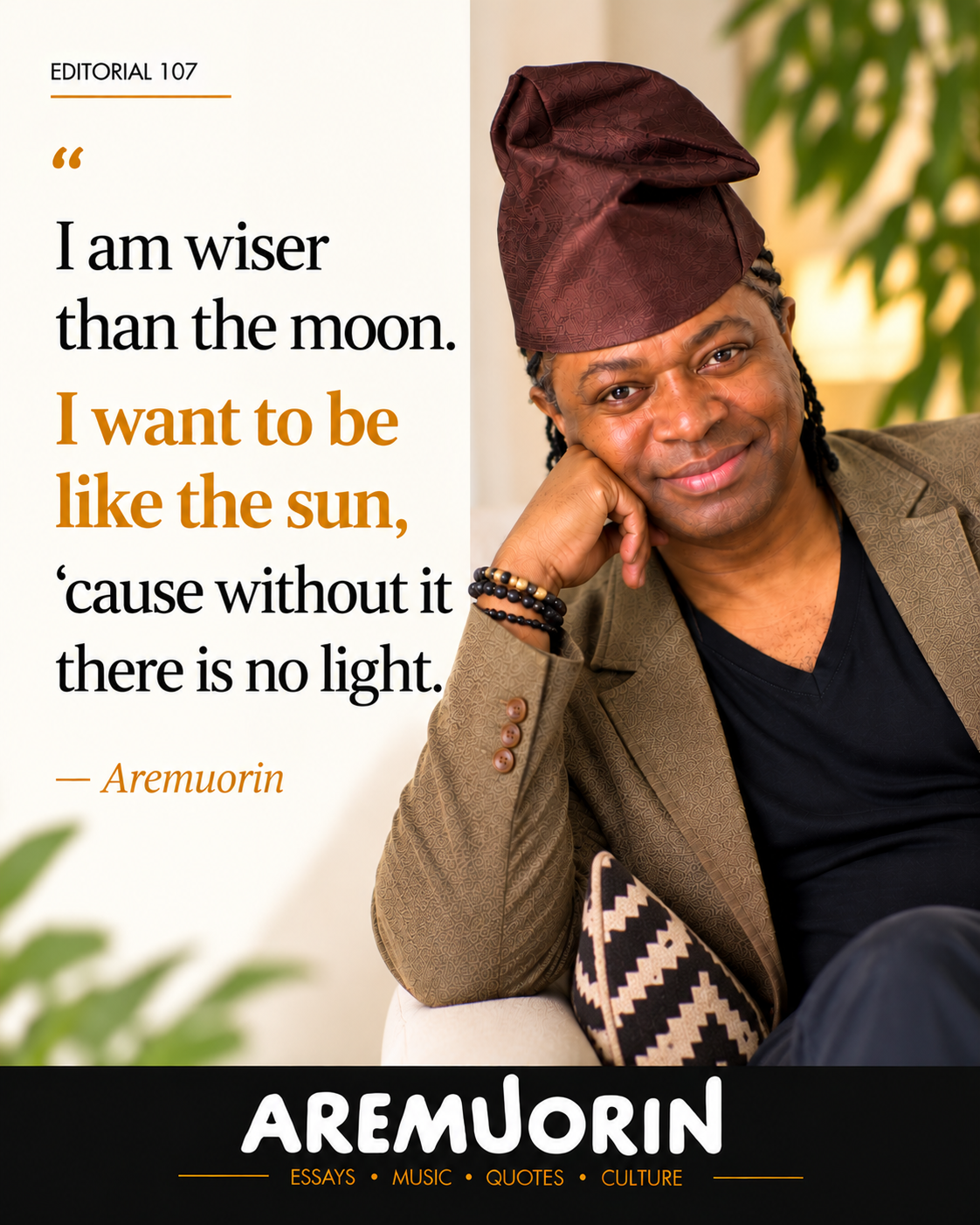
Editorial 107 | The Aremuorin Journal
We are often taught to admire what shines. Less often are we encouraged to ask where the light comes from, what it reveals, or what responsibility belongs to the person who carries it. In a culture that can confuse visibility with value, that distinction deserves a closer look.
“I am wiser than the moon. I want to be like the sun, ’cause without it there is no light.”
— Aremuorin
At first glance, this is a statement about wisdom and aspiration. Look again, and it becomes a question about purpose: do we want only to be seen, or do we want to contribute something that helps others see?
The difference between reflecting light and creating change
The moon has a beauty all its own. It guides the eye through darkness, marks time and has inspired poets, navigators and generations of observers. Yet its familiar glow is reflected sunlight. The sun, by contrast, radiates its own light.
The comparison is not an argument that one is worthless and the other worthy. Both occupy their place. The question is what the image asks of us as human beings. Are we content to reflect whatever happens to shine upon us—other people’s opinions, fashionable ideas, borrowed status and inherited expectations—or are we willing to cultivate a contribution that is genuinely our own?
Reflection has its value. We learn by observing, listening, studying and standing on the shoulders of those who came before us. Nobody creates in a vacuum. But learning becomes limiting when imitation is the final destination. Wisdom must eventually become discernment: the ability to examine what we have inherited, decide what remains useful, and have the courage to revise what no longer serves us.
Wisdom begins when we question what we have accepted
Many beliefs survive not because they have been tested and found true, but because they have been repeated for so long that questioning them feels like disloyalty. Tradition can carry knowledge, belonging and hard-won lessons. It can also preserve prejudice, unequal rules and assumptions that have outlived the conditions in which they arose.
Respecting the past does not require surrendering our judgement to it. A mature society should be able to ask: Who does this rule protect? Who bears its cost? What evidence supports it? Does it help people flourish, and can we improve it without losing what is valuable?
Questioning is not the same as rejecting everything. It is the work of separating what has been proven useful from what merely feels familiar. Some old ideas deserve preservation; others need reform, and some should be left behind. The point is not rebellion for its own sake. It is responsible discernment.
When we stop asking questions, we can mistake obedience for wisdom and repetition for truth. Introspection gives us a chance to notice the difference.
Ambition without diminishment
To want to be like the sun is to imagine a life of contribution. It is to want our work, choices or presence to make something clearer, kinder, more possible or more just. That aspiration need not be an act of superiority. It can be an expression of responsibility.
There is a difference between wanting to shine and needing someone else to appear smaller. One seeks to develop a gift; the other depends on comparison. One asks, “What can I build?” The other asks, “How can I outrank you?” The first can create value. The second can consume a lifetime without producing much beyond rivalry.
Healthy ambition leaves room for other people to flourish. It recognises that different people carry different gifts, and that a meaningful world needs more than one kind of light. We do not have to occupy the same role to share a common purpose. Nor must we imitate another person’s path to prove that our own is worthwhile.
Influence is a responsibility, not just a spotlight
Visibility can open doors, but visibility alone is not evidence of value. A person may attract attention without offering insight; another may quietly change a life without ever becoming widely known. The reach of a message matters, but so do its substance, its consequences and the care with which it is delivered.
If we have a platform, skill, knowledge or opportunity, a useful question follows: what does it make possible for someone beyond ourselves? Does it encourage independent thought? Does it share knowledge without humiliating the learner? Does it challenge an unfair norm without replacing it with another form of cruelty? Does it leave people better equipped to make their own decisions?
Real influence is not measured only by how many people look in our direction. It is also measured by what they can see more clearly after they have listened.
The humility to keep learning
To aspire to illuminate is not to claim that we possess every answer. In fact, the more seriously we take wisdom, the more carefully we should handle certainty. We can be confident in our principles and still revise our conclusions when stronger evidence, deeper understanding or another person’s experience reveals a gap in our thinking.
Introspection is not endless self-criticism. It is an honest review of our motives, choices and effects. What worked? What failed? What did we misunderstand? Whom did our decisions leave out? What should we carry forward, and what should we have the courage to change?
These questions matter in private life, in creative work, in leadership and in public institutions. A legacy worth passing on is not a story in which we were always right. It is a record of lessons learned, errors acknowledged, truths tested and improvements made possible because somebody was willing to think again.
A spiritual reading of light
For readers who approach life through faith, the image of light may also suggest a source beyond the self: divine wisdom that guides, corrects and gives purpose. From that perspective, being a light to others is not a claim to be the ultimate source of truth. It is a call to serve with humility, to act with integrity and to use whatever gifts one has been given responsibly.
Others may read the image in humanist, philosophical or creative terms. The language can differ while the central question remains: how can what we know, make or do help life become more thoughtful and humane?
Light is most useful when it reveals rather than blinds. It should help us see people more clearly—not turn them into an audience for our own importance.
What will our light leave behind?
Every generation inherits a world shaped by decisions it did not make. We receive discoveries and wisdom alongside unresolved conflicts, unjust systems and mistakes that were never properly examined. Our task is not to condemn everything that came before us, nor to defend it all. Our task is to learn well enough to leave the next generation with better choices.
That means preserving what works, being honest about what does not, and making room for evidence, empathy and imagination. It means challenging norms when they have become harmful or detached from reality, while resisting the temptation to treat every new idea as automatically superior. Progress requires both courage and judgement.
Perhaps wisdom is not simply knowing how to shine. Perhaps it is understanding when to question, when to listen, when to lead, when to change course and when to help someone else find their way.
The ultimate measure is not how brightly we appear to shine. It is what our light helps others to see—and what they are able to build once they can see it.
What kind of light are you bringing into the world?
It is easy to want recognition. It is harder—and more worthwhile—to consider what our presence contributes.
What is one thing you could do this week to bring greater clarity, encouragement or meaningful change into someone else’s life?
Share your reflections in the comments, and pass this essay to someone who might see themselves differently after reading it. Continue exploring questions of wisdom, creativity, purpose and culture in the Aremuorin Journal.
Editorial 107 — Aremuorin


Leave a Reply