By Aremuorin™ / Contact / Mailing List / Linktree / Latest Post / Telegram – Let’s keep the conversation going !!!
By Aremuorin™ / Contact / Mailing List / Linktree / Latest Post / Telegram – Let’s keep the conversation going !!!
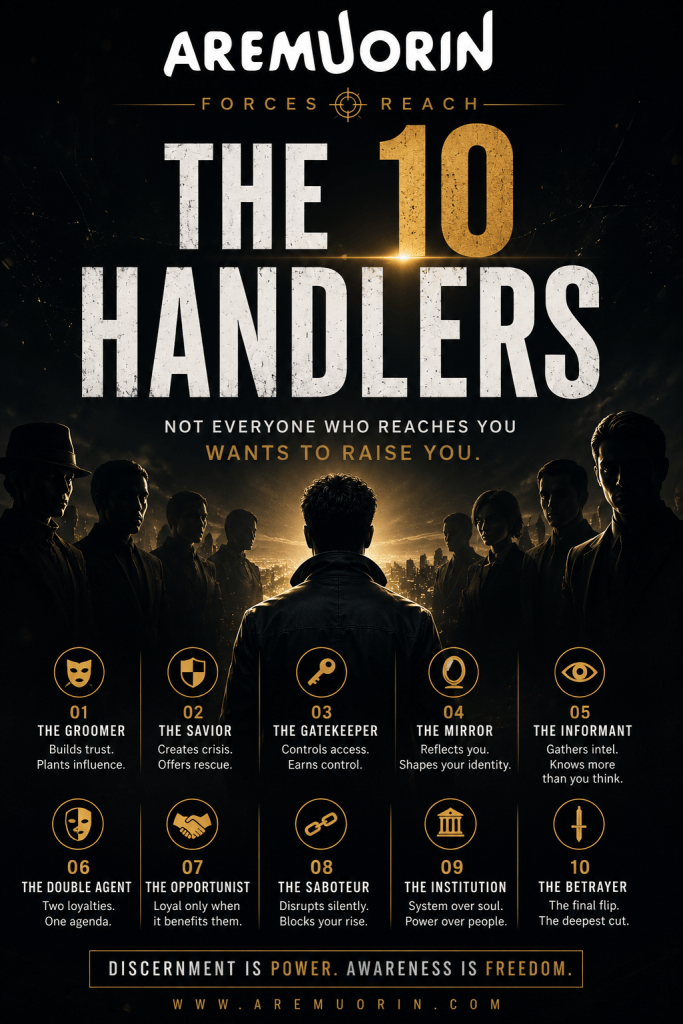
THE 10 HANDLERS
Not every relationship begins as it appears. Some are cultivated. Some are strategic. And some… are designed to handle you.
Introduction: The Illusion of Organic Connection
Human beings are wired for trust. From tribal bonds to modern relationships, connection is our survival currency. Yet history and psychology repeatedly shows that not all relationships are organic.
Some are engineered.
As sociologist Erving Goffman noted: “We are all actors on a stage, but some are also directors of others.”
1. The Groomer
Strategy: Slow trust-building over time
Psychology: Attachment conditioning
They invest early. They listen, mirror, and validate until trust becomes dependency.
2. The Savior Handler
Strategy: Crisis then rescue
Psychology: Trauma bonding
They appear at your lowest moment, offering salvation but often create or benefit from the chaos itself.
3. The Gatekeeper
Strategy: Control access
Psychology: Scarcity principle
They stand between you and opportunity, shaping your path by limiting or granting access.
4. The Mirror Handler
Strategy: Identity reflection
Psychology: Narcissistic mirroring
They become what you need them to be—until you realize it was never real.
5. The Informant
Strategy: Intelligence gathering
Psychology: Social penetration
They observe, listen, and collect details often without immediate purpose.
6. The Double Agent
Strategy: Dual loyalty
Psychology: Cognitive dissonance
They serve two masters while convincing each they are loyal.
7. The Opportunist Handler
Strategy: Situational loyalty
Psychology: Social exchange theory
They align when beneficial and disappear when it no longer serves them.
8. The Saboteur
Strategy: Silent disruption
Psychology: Envy and projection
They support you publicly, but quietly undermine your progress.
9. The Institutional Handler
Strategy: Systemic control
Psychology: Authority bias
Not a person but a system. Organizations can shape behavior, belief, and dependency.
10. The Betrayer
Strategy: The final pivot
Psychology: Moral disengagement
The one who flips. The one you trusted. The one you didn’t see coming.
Why This Matters
Humans are wired to trust familiarity, consistency, and emotional investment. That wiring can be exploited.
- We trust what feels familiar
- We trust emotional closeness
- We trust consistency even when it’s manufactured
Antidotes: Protecting Your Power
- Pattern recognition over emotion
- Independent verification
- Boundaries as strategy
- Time reveals truth
- Self-trust first
As Carl Rogers said: “The curious paradox is that when I accept myself, then I can change.”
Closing Reflection
This is not about paranoia. It is about awareness.
Because the most effective handlers are not obvious enemies.
They are trusted allies until they are not.
Discernment is power. Awareness is freedom.
From the Author: Aremuorin
The ideas explored here, ownership, legacy, and cultural infrastructure are not just theoretical. They underpin my work as an independent artist.
Selected works by Aremuorin
— Aremuorin
Thoughts. Culture. Truth.
About Aremuorin
Aremuorin is a multi-awardee writer, jazz soul artist, and cultural strategist.
No.1, 49+ weeks on the Jazz Charts.
Cultural Infrastructure Archive & Research.
For research, collaboration or contributions:
aremuorin@aremuorin.me
THE 10 HANDLERS
Not every relationship begins as it appears. Some are cultivated. Some are strategic. And some… are designed to handle you.
Introduction: The Illusion of Organic Connection
Human beings are wired for trust. From tribal bonds to modern relationships, connection is our survival currency. Yet history and psychology repeatedly shows that not all relationships are organic.
Some are engineered.
As sociologist Erving Goffman noted: “We are all actors on a stage, but some are also directors of others.”
1. The Groomer
Strategy: Slow trust-building over time
Psychology: Attachment conditioning
They invest early. They listen, mirror, and validate until trust becomes dependency.
2. The Savior Handler
Strategy: Crisis then rescue
Psychology: Trauma bonding
They appear at your lowest moment, offering salvation but often create or benefit from the chaos itself.
3. The Gatekeeper
Strategy: Control access
Psychology: Scarcity principle
They stand between you and opportunity, shaping your path by limiting or granting access.
4. The Mirror Handler
Strategy: Identity reflection
Psychology: Narcissistic mirroring
They become what you need them to be—until you realize it was never real.
5. The Informant
Strategy: Intelligence gathering
Psychology: Social penetration
They observe, listen, and collect details often without immediate purpose.
6. The Double Agent
Strategy: Dual loyalty
Psychology: Cognitive dissonance
They serve two masters while convincing each they are loyal.
7. The Opportunist Handler
Strategy: Situational loyalty
Psychology: Social exchange theory
They align when beneficial and disappear when it no longer serves them.
8. The Saboteur
Strategy: Silent disruption
Psychology: Envy and projection
They support you publicly, but quietly undermine your progress.
9. The Institutional Handler
Strategy: Systemic control
Psychology: Authority bias
Not a person but a system. Organizations can shape behavior, belief, and dependency.
10. The Betrayer
Strategy: The final pivot
Psychology: Moral disengagement
The one who flips. The one you trusted. The one you didn’t see coming.
Why This Matters
Humans are wired to trust familiarity, consistency, and emotional investment. That wiring can be exploited.
- We trust what feels familiar
- We trust emotional closeness
- We trust consistency even when it’s manufactured
Antidotes: Protecting Your Power
- Pattern recognition over emotion
- Independent verification
- Boundaries as strategy
- Time reveals truth
- Self-trust first
As Carl Rogers said: “The curious paradox is that when I accept myself, then I can change.”
Closing Reflection
This is not about paranoia. It is about awareness.
Because the most effective handlers are not obvious enemies.
They are trusted allies until they are not.
Discernment is power. Awareness is freedom.
From the Author: Aremuorin
The ideas explored here, ownership, legacy, and cultural infrastructure are not just theoretical. They underpin my work as an independent artist.
Selected works by Aremuorin
— Aremuorin
Thoughts. Culture. Truth.
About Aremuorin
Aremuorin is a multi-awardee writer, jazz soul artist, and cultural strategist.
No.1, 49+ weeks on the Jazz Charts.
Cultural Infrastructure Archive & Research.
For research, collaboration or contributions:
aremuorin@aremuorin.me


Leave a Reply